Which are the internet conversation media?
In order to list, characterize and differentiate the internet conversation media, we have elaborated the taxonomy presented in this chapter. Taxonomy is the science of classification. When we establish a taxonomy, we are better able to recognize the different conversation media and to identify the characteristics of each in comparison with the others. We are also able to identify and classify the conversation media implemented in conversation services of different computing systems. Using this taxonomy, we intend to discuss the potential and the restrictions of conversation in each medium, and also to warn about some conceptual errors and abuses in terminology. Without a good taxonomy, we would run the risk of making inadequate analyses and establishing comparisons between unrelated things.
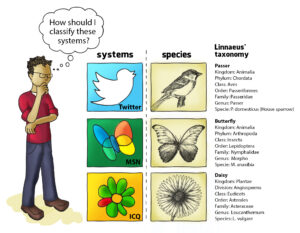
Taxonomies are employed in different areas. In Biology, taxonomy is fundamental for the identification, description, nomenclature and classification of living beings. For a biologist, the taxonomy of living beings supports the identification of characteristics that differentiate, for example, a human being from a chimpanzee.
Taxonomy of living beingsIn the classification of living beings based on the Taxonomy of Linnaeus (1735), units of classification, or taxa, correspond to groups of organisms with common characteristics. Each taxon has a name and corresponds to a hierarchical level in the Taxonomy of Linnaeus, composed of seven main levels: Kingdom, Phylum, Class, Order, Family, Genus and Species. Living beings are classified according to criteria such as morphological, evolutionary, functional and behavioral aspects. The graphic representation of the Taxonomy of Living Beings is the Tree of Life or phylogenetic tree, a diagram in the shape of a tree in which each node represents a common ancestor among descendants. |
In order for us to elaborate a taxonomy of conversation media, first we have to recognize which are the culturally established media so that later we can search the literature for the classification criteria that characterize and differentiate them. In this chapter, we establish what needs to be classified in the field of computing mediated conversation; we elaborate a model for the identification of media; we discuss the criteria adopted to differentiate and characterize media; we discuss how to identify a medium that is implemented in a given conversation service such as those we find on Facebook; and we discuss a few misunderstandings in the identification of similar media.
System, service, medium, or textual genre?
If we ask you which email systems do you know, you might mention Gmail and Hotmail. Indeed, Gmail implements an email service, but also contains an instant messenger service (Google Talk), and, therefore, it wouldn’t be correct to say it was only an email system. And how about Facebook, how can we classify it? A microblog system?
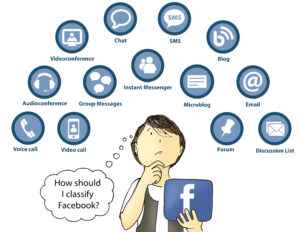
Facebook is classified as a social network system, and in this system are implemented several conversation services – not just a microblog, but also an instant messenger, an email service and even a forum.
<Conversation services implemented on Facebook
Messages. It’s an email service, since it allows the asynchronous exchange of private messages (to one or few people), with the text being able to include attached files.
News Feed. It’s a microblog, since users divulge short messages (their status) that are read and commented later by the friends that follow them (asynchronous and centered conversation).
Group Publication. It’s a forum, since all members discuss posts (topics).
Chat. It’s an instant messenger, since users establish synchronous conversations with any friend (private conversation) exchanging short textual messages.>
A conversation medium is a specific way of exchanging messages. For example, if we ask how the conversation on an instant messenger takes place, you will explain that the user needs to have a list of friends that have signed up to the same system, and that the user can establish a private conversation in real time (synchronous) with any friend who is online. Notice that this description can be used regardless of the system – this mode of conversing, which is established through an instant messenger, is implemented on Facebook, Google Talk, MSN, ICQ, and other systems. Therefore, a conversation medium is an abstraction. In order for the conversation to take place, the medium needs to be implemented in a computing system – the implementation of a medium in a system is what we call a conversation service.
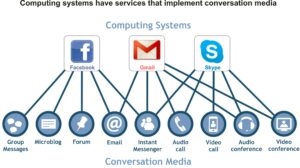
A computing system provides services that implement conversation media. For example, on Facebook, we can publish a message that will be followed by our friends in the “News Feed” service, which is a microblog; through the “Chat” service, we establish private conversations with friends through instant messages; through the “Messages” services we send email messages and can even attach files; and we also talk in a “Group”, through a forum. Another example: Skype has several conversation services that implement different media in order to allow synchronous conversations, among which we recognize instant messenger, voice and video call, audioconference and videoconference. Even Gmail, which in its first versions only had an email service, today contains the implementation of other conversation media, such as instant messenger (Google Talk), voice call, video call, audioconference and videoconference (Hangouts).
Last century, the usual thing was for one system to implement only one conversation medium, so it was common for us to classify systems as an “email system” or a “videoconference system”. With the development of the web, and particularly of the web 2.0, the most common thing now is for a system to implement several conversation media, such as social network systems do. As a consequence, it became impossible to classify computing systems according to the conversation media they implement. We recognize that conversation services are the units that are classified according to the conversation medium.
In this book, we’re going to abuse the terminology by employing the term “conversation system” in order to define any system that contains conversation services – in that sense, Facebook, which is a social network system, is also a conversation system. We also consider that it’s an abuse of the terminology to say “email system”, because we recognize that currently a system contains multiple conversation systems – thus, we prefer to use the term email service. Even more than an abuse of terminology, we consider it inadequate to say that chat, blog or videoconference are textual genres.
Textual genreThe definition of genre is centered in the purpose of the discourse, and not just in the form or the content of the text (Miller, 1984). Genres are different types of texts found in recurring communication situations, are related to culture and are historically and socially determined. |
We recognize that the services of a same conversation medium allow the composition of texts of different genres – for example, a chat service can be used for online sex, an interview or a debate. Texts of a given genre can be produced in services that implement different media, for example, an interview can be conducted through a chat service or an email service. For these reasons, we consider that the chat is a medium, not a genre or a system. We reiterate that textual genres are not the object of our classification.
A model of internet conversation media
In order for us to begin answering the question that we asked in the beginning of this chapter – what are the internet conversation media? – we need to consider that the recognition of these media depends on culture, because they are historically and socially determined. Considering the historic importance and the social recognition until publication time, we identified the following conversation media: email, discussion list, forum, blog, microblog, instant messenger, SMS, chat, group messages, video call, videoconference, voice call and audioconference. We represent these media in the model presented in the following illustration. A model is a logical or mathematical description represented in an abstract, conceptual or graphic form. We have elaborated this model in order to aid the identification, analysis and classification of internet conversation media.
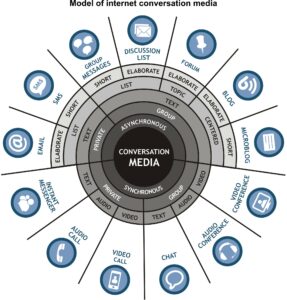
Each medium is characterized by a different mode of conversation. In the following dictionary we explain the mode of conversation that characterizes each medium listed in the model, which includes examples of popular systems that make any service that implements that conversation medium available to users. The characteristics of each medium are based in the criteria discussed in the following section.
Dictionary of internet conversation media
 |
Voice call (telephone conversation) Synchronous conversation medium with audio transmission for two interlocutors. Examples: Skype, WhatsApp Calling, Viber, Facebook Calling |
 |
Audioconference Synchronous conversation medium with audio transmission for small groups. Examples: UberConference, FreeConferenceCall |
 |
Chat Synchronous conversation medium for discussion among small groups through the exchange of short text messages. Examples: mIRC, Paltalk, Facebook Chat |
 |
Blog Asynchronous conversation medium in which an author posts elaborate text messages that are open to comment. Examples: WordPress, Blogger, Facebook Pages |
 |
Email (electronic mail) Asynchronous conversation medium between two (or few) interlocutors that exchange elaborate text messages. Examples: Gmail, Hotmail, Facebook Messages |
 |
Forum Asynchronous conversation medium for discussion among many interlocutors that exchange elaborate text messages, organized by topic. Examples: phpBB, vBulletin, Facebook Groups |
 |
Discussion List Asynchronous conversation medium for discussion among many interlocutors that send elaborate text messages, organized by list. Examples: Google Groups, Yahoo Groups |
 |
Instant Messenger Synchronous conversation medium in which two interlocutors exchange short text messages. Examples: ICQ, MSN Messenger, Facebook Messenger |
 |
Group Messages Asynchronous conversation medium for discussion among small groups through the exchange of short text messages. Examples: WhatsApp, Facebook Group Conversation |
 |
Microblog Asynchronous conversation medium in which the author posts short text messages that are open to comment. Examples: Twitter, Tumblr, Facebook News Feed (timeline) |
 |
SMS Asynchronous conversation medium for two interlocutors that exchange short text messages. Examples: WhatsApp, Handcent |
 |
Video call Synchronous conversation medium for two interlocutors with audio and video transmission. Examples: Skype, FaceTime |
 |
Videoconference Synchronous conversation medium with audio and video transmission for small groups. Examples: Skype, Hangouts |
We managed to identify 13 different conversation media. On the one hand, it’s surprising that there are so many different ways to talk supported by computer networks, particularly if we consider the fact that before computing we knew of few ways to converse other than face-to-face conversation (disregarding unidirectional communication media that are not characterized as conversation media): letter, telegraph, telephone, amateur radio and teleconference via television. On the other hand, it’s also surprising to find out that it’s possible to list only 13 different modes of establishing a conversation through the internet, due to the great diversity of conversation services implemented in countless computing systems.
The media evolve, and that’s why the list presented here needs to be reviewed and brought up to date from time to time. It’s possible that a system has already innovated to the point of implementing a conversation service that can be characterized as a new medium; however, the new mode of communication needs to have a social usage in order to be consolidated as a medium that is relevant enough to be included in the model proposed here. It needs to be recognized by users, system developers, researchers or the specialized media. Preferably, this new medium has to be implemented in a few popular systems, which characterizes its relevance.
Criteria for classification
The elaboration of a taxonomy consists in grouping elements with common attributes, arranging them in groups and labeling them, producing a classification. The classification, which makes the identification and differentiation of elements possible, is done following criteria that are generally established by experts in the field. We selected from the literature the criteria of classification that we considered more adequate to characterize and differentiate the conversation media listed in the model we elaborated. The criteria selected needs to be sufficient to give each conversation medium a unique classification.
It’s important to remember that the differences among conversation media are not associated with the user interfaces of the systems or the support – the differences lie in the way the act of conversation takes place, that is, the possibilities and restrictions imposed for the establishment of conversation in each medium. In this sense, we have identified that the criteria are associated with the possibilities of interaction among interlocutors and with the characteristics of the messages exchanged in these media.
As regards the interaction among interlocutors, we emphasize that the object this book studies is the conversation, and that interlocutors are at once senders and receivers of messages. The criteria that we consider relevant regarding the variations in the characteristics of the interaction among interlocutors are: conversation synchronism, relationship among interlocutors, conversation privacy and number of interlocutors.
The characteristics of each medium, its possibilities and restrictions, shape the discourse. Regarding the variations in the characteristics of the messages, in terms of format and not content, we have recognized the following criteria to differentiate the media: language form, message organization and message size.
Conversation synchronism
Conversation media are divided among those that allow conversations that are synchronous, live and in real time; and those that allow conversations that are asynchronous, in which interlocutors don’t need to be connected at the same time. This differentiation is based on the classic system of space-time classification (Ellis et al., 1991) of which we have adopted only the criterion of time, separating the synchronous and asynchronous media. The criterion of space was not adopted because it doesn’t differentiate the conversation media, since they are designed to establish remote communication, in which interlocutors are distributed among different localities (and not face-to-face in the same place).
Synchronous media imply a discourse that is very different from the discourse in asynchronous media. When the conversation is synchronous, the message sent is received practically in the same instant. The discourse is more similar to face-to-face conversation, and a more informal language is commonly used, possessing the characteristics of orality. Because they are connected at the same time, interlocutors expect a faster answer. The fast exchange of messages and the informality of the discourse strengthen the feeling of presence. Due to these characteristics, the discourse tends to have a more personal, emotionally charged tone. We generally choose to use synchronous media when the conversation is informal, when we need an urgent response or when we know that the other person is also connected and it’s not a problem to interrupt their activities to have the conversation. Systems that implement synchronous conversation services need to show information about the presence and the status of interlocutors at the moment of conversation.
In asynchronous conversations, when the message is stored and will be retrieved later, interlocutors don’t expect an immediate response and interactions can occur throughout a longer period of time. Having more time, interlocutors elaborate the content of the message, revise it before sending it, consult other texts and references, insert images, videos and documents. Asynchronous conversations, therefore, promote a more formal, polite and educated discourse. We choose to use asynchronous media when we don’t have the need to establish an immediate conversation, aren’t sure whether our interlocutors are available for a conversation, need to better elaborate the message or need to receive a formal answer. Systems that implement asynchronous conversation services need to handle the conversation history.
Aside from the synchronous/asynchronous dichotomy, by analyzing the conversation synchronism we found that conversation media have different expected response times. For example, we expect that an email message will be answered by the following day, finding it reasonable if the response comes in a few hours, but not reasonable that it should take more than a couple of days. On instant messenger, we expect a much faster response, finding it reasonable if it comes in a few seconds, but not reasonable that it should take a couple of hours (or we wouldn’t characterize it as an “instant” message). Thus, conversation media are distributed over a spectrum according to the expected response time, in which synchronous media present a response that tends to be immediate, while in asynchronous media the expected response time is longer.
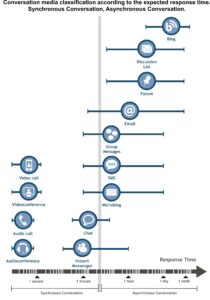
In synchronous media, the interaction between interlocutors is established in a short period of time, such as few seconds or minutes. In voice and video calls, and in audio and videoconferences, the time of transmission of the audio and video must be only a few milliseconds, in order not to compromise the quality of the conversation. In textual media such as instant messengers and chats, the time between receiving a message and answering it can take a few dozen seconds or a few minutes without compromising the conversation – some authors even prefer to classify these media as quasi-synchronous, because they are farther apart from face-to-face conversation, due to the fact that messages are received only after they have been completely formulated, instead of being received during the process of formulation (with the exception of services that transmit texts character by character while they’re being typed).
In this book conversation media was distributed over a spectrum according to the expected response time. Kock (2004) did something analogous by comparatively characterizing these media according to their similarity with face-to-face conversation, a criterion she calls “media naturalness”. Since pre-historical times, mankind is biologically adapted to communicate face-to-face, so the bigger the difference between a conversation medium and face-to-face communication, the more obstacles to communication this medium will present, because it will demand more cognitive effort from interlocutors, and, thus, the lesser naturalness it will have. The most natural conversation media are the ones closest to a face-to-face conversation, with video call and videoconference being the most natural of all, because they allow speech, gestures and looks to be conveyed. Asynchronous conversation media that require the use of written language and elaborate messages (such as emails or blogs) are less natural than synchronous media (such as instant messengers), which present quicker responses and language that is more informal and has characteristics of orality that are closer to face-to-face conversation. Moreover, from our point of view, the naturalness of media is related to the expected response time that characterizes the conversation synchronism: the longer the average response time, the more elaborate and literate, and the less natural, the discourse.
It’s important to stress the fact that the expected response time for some asynchronous media is becoming shorter due to: the popularization of the use of smartphones that allow users to stay connected all the time, the great number of interlocutors online, message alerts and greater transmission capacity on the web. For example, on Facebook, one user has hundreds of friends/followers and it’s probable that a few of them will be online synchronously, ready to immediately answer the message that was just sent via microblog, bringing characteristics of synchronous conversation to this asynchronous medium. The same thing happens with the media SMS and group messages – even though messages can be answered quickly, they are in fact asynchronous conversation media, because the messages are stored in order to be read at any later time.
Conversation privacy and number of interlocutors
Another relevant criterion to differentiate conversation media is conversation privacy, which is related to the number of interlocutors that participate in it. Some media establish private conversations, restricted to only two interlocutors, while other media establish conversations among several people, ranging from small groups to a crowd.
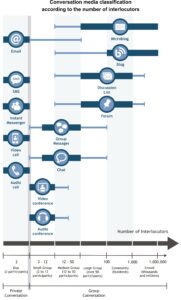
In a private conversation, restricted to two people, the discourse tends to be more personal and informal, more intimate, because the interlocutors bring to it situational references lived by both. In a group conversation, when we send a message to many people, the discourse tends to be more universal and formal.
It’s important to problematize the notion of private and public conversation in the services that implement conversation media. For example, even if you can restrict a given post to only your Facebook friends, all it takes is for one friend to share it and the friends of that friend will also have access to it. Furthermore, an email conversation exchanged between two people can be forwarded or answered having other recipients included. The way of recording the message confers such permanence and facility of transcription (sharing, forwarding, retweeting) that the privacy of online communication is never guaranteed. However, if any interlocutor makes public a message that was sent in private, either intentionally or inadvertently, they are transgressing the boundaries of politeness, which causes tensions between interlocutors. In spite of the fact that they don’t guarantee privacy, systems are designed to establish conversations that are perceived as being private or in group – that’s why this criterion is relevant to characterize conversation media.
Relationship among interlocutors
Conversation media also restrict the relationship among interlocutors during a conversation: this relationship can be one-to-one, all-to-all and all-to-one. The relationship among interlocutors is bidirectional, which marks the difference between conversation media and mass communication media, which establish a unidirectional one-to-all relationship, with the communication centered in one emission pole without the possibility of audience feedback.
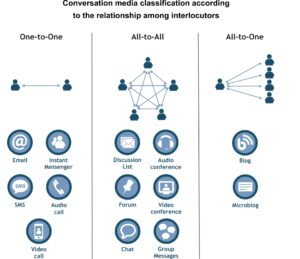
In media such as instant messengers and SMS, that establish private conversations, the relationship between interlocutors is one-to-one, that is, the message is sent directly to one person, who, in turn, answers it. In discussion media, such as discussion lists and forums, the relationship is all-to-all, since everyone sends messages that are received by everyone, and anyone can answer the received message. In blogs and microblogs, an assymetry is imposed among the interlocutors of a conversation, because the exchange of messages is centered on the posts of one single individual: the author publishes a post to all, and all followers can answer that specific message (all-to-one relationship). This is new, not only because both media have been developed more recently, but mainly because they allow the conversation among crowds like no other medium (as shown in the illustration about number of interlocutors), which, in a way, is reminiscent of mass communication media. However, these are in fact conversation media, given that there is the possibility of commenting on the message, which establishes the conversation.
Language form
As regards the characteristics of the message, the most notable criterion that differentiates one medium from another is the language form: text, audio, or video.
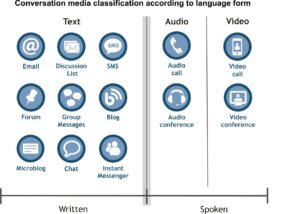
Language form has a great influence over discourse. Audio and video-based media, which records speech, make the discourse more similar to face-to-face conversation. Text-based media, on the other hand, in which the conversation takes place through writing, present more formality in the discourse, particularly when the media is asynchronous.
From the linguistic point of view, a “text” is the discourse that is manifested through writing or through speaking. We, however, have adopted the point of view of informatics, in which the spoken language is recorded by audio and video files, while the written language is recorded by text file (through character encoding, such as in ASCII codes). It’s important to emphasize that the services that implement text-based media frequently allow users to enrich messages with attached emoticons, images, animations, voice recordings and even video clips – in that case, multimedia is a complement of the written message and does not constitute the language that is the basis of conversation in these media.
Message organization
The former criteria are not sufficient to differentiate all media. For example, what differentiates the discussion list from the forum is the fact that in the former, messages are organized chronologically, listed according to when they were posted, while in the latter messages are organized by topic and frequently presented hierarchically according to the chain established on the threads. The message organization in the log, which is the record of the conversation, has a great influence over the discourse.
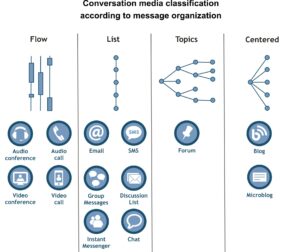
In media where the message is transmitted while it’s being produced, such as audio and video-based media, messages are organized in a continuous flow, which makes the occurrence of superposition of voices possible; thus, in order to coordinate the conversation, interlocutors have to follow the social protocol of “one at a time”; few interlocutors can participate in the conversation at the same time (notice the small number of interlocutors expected in these media).
In media where the message is sent after it was formulated, messages are organized according to one of the following topologies: list (as in emails and discussion lists), which promotes a sequential discussion that privileges the chronological order of messages; topics (as in forums), in which the conversation is organized by topic and there’s the frequent representation of the response relationship among messages (threads), which promotes the depth and divergence of the discussion; or centered (as in blogs and microblogs), which promotes a discussion focused on the initial message and on the interests of the original poster.
A few systems have adopted, without much success the graph topology (network among messages). This is a more complex topology that allows the establishment of several relationships among messages, making it more difficult to understand the conversation. Currently, there are no culturally relevant conversation media that structure messages in a network.
Message size
We still need to make use of one more criterion of classification to differentiate media like blogs and microblogs: message size. In all synchronous media, messages tend to be shorter as a consequence of the short expected response time. Asynchronous media are the ones where we find the greatest differences according to the expected quantity of text by message; in some of them, the message tends to be short, without much text, while in others it tends to be more elaborate, having longer texts.
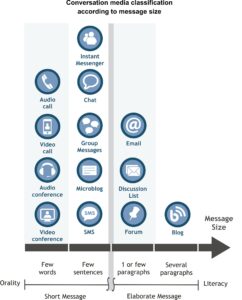
Longer messages, with plenty of text, require more time to write, read and ponder on the elaboration of the answer; they promote a more formal, elaborate, literate discourse. Short messages make interaction quicker because they shorten the response time that is necessary for message elaboration, require less time to type and are often sent without text revision – so much so that it’s common, on instant messengers and chats, for a person to send a message correcting the previous text, because the mistake is only noticed when the person rereads the message after having sent it, when it’s no longer possible to correct the original text. In these media, the urgency of the interaction is more important than the formality of written language. People use emoticons :-D, abuse punctuation !!!, make their vowels looooooooonger, among other resources that give more emotion and incorporate characteristics of oral discourse in the typed message.
The production of short messages is imposed, in some systems, by the limitation in the number of characters per message, as for example on Twitter (messages restricted to 140 characters), SMS (160 characters) and the IRC chat protocol (510 characters). Even if not by imposition, the interface and the functionalities of the conversation service induce the production of either short or elaborate messages, because they supply clues about the expected amount of text. For example, most email services present a typing area with dozens of lines, leading users to believe that they are supposed to type plenty of text there; they also present functionalities for formatting texts and sending files attached to the message, indicating that the message can be more elaborate than a simple text; and, when users select messages to read, they’re usually presented as occupying the entire screen, one at a time – anything to indicate, induce or adapt to the reality that email produced texts are elaborate. On the other hand, in most microblog implementations, only one or few lines of text are initially presented for the typing of a new message, functionalities for text formatting are generally not made available, and messages are presented one after another on the screen – anything to induce the production of short messages.
Differentiation of media according to the criteria
In the following chart, we present a selection and synthesis of the criteria discussed in the previous section. This chart represents the taxonomy that we have proposed for the characterization and careful differentiation of conversation media.
| MEDIA | CRITERIA | |||||
| synchronicity of conversation | privacy of conversation | language form |
message organization | message size | ||
|
asynchronous | private | text | list | elaborate | |
|
SMS | asynchronous | private | text | list | short |
|
Blog | asynchronous | group | text | centered | elaborate |
|
Microblog | asynchronous | group | text | centered | short |
|
Forum | asynchronous | group | text | topics | elaborate |
|
Discussion List | asynchronous | group | text | list | elaborate |
|
Group Messages | asynchronous | group | text | list | short |
|
Instant Messenger | synchronous | private | text | list | short |
|
Audio call | synchronous | private | audio | flow | short |
|
Video call | synchronous | private | video | flow | short |
|
Chat | synchronous | group | text | list | short |
|
Audioconference | synchronous | group | audio | flow | short |
|
Videoconference | synchronous | group | video | flow | short |
The taxonomy presented in this chart can also be represented graphically in the form of an upside-down tree, such as the one in the following illustration.
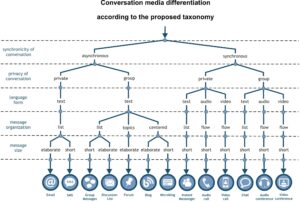
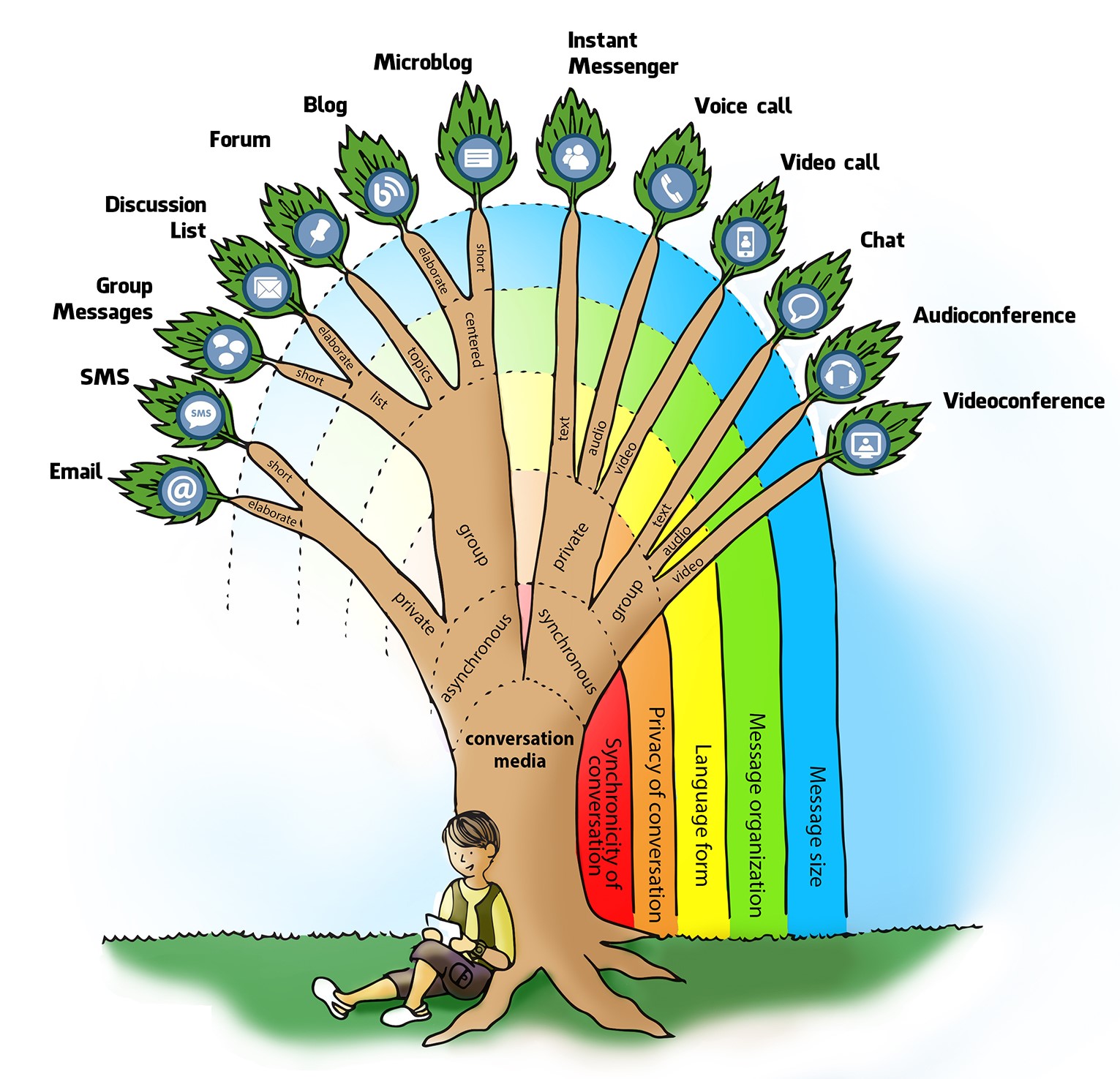
The illustration that opens this chapter was elaborated based on this tree: it’s a simplified tree in which we registered only the values that differentiate the media. That illustration is a reference to the Tree of Life (used in Biology); however, while the Tree of Life represents the common ancestor between two species, the tree illustrated here represents the differences among conversation media.
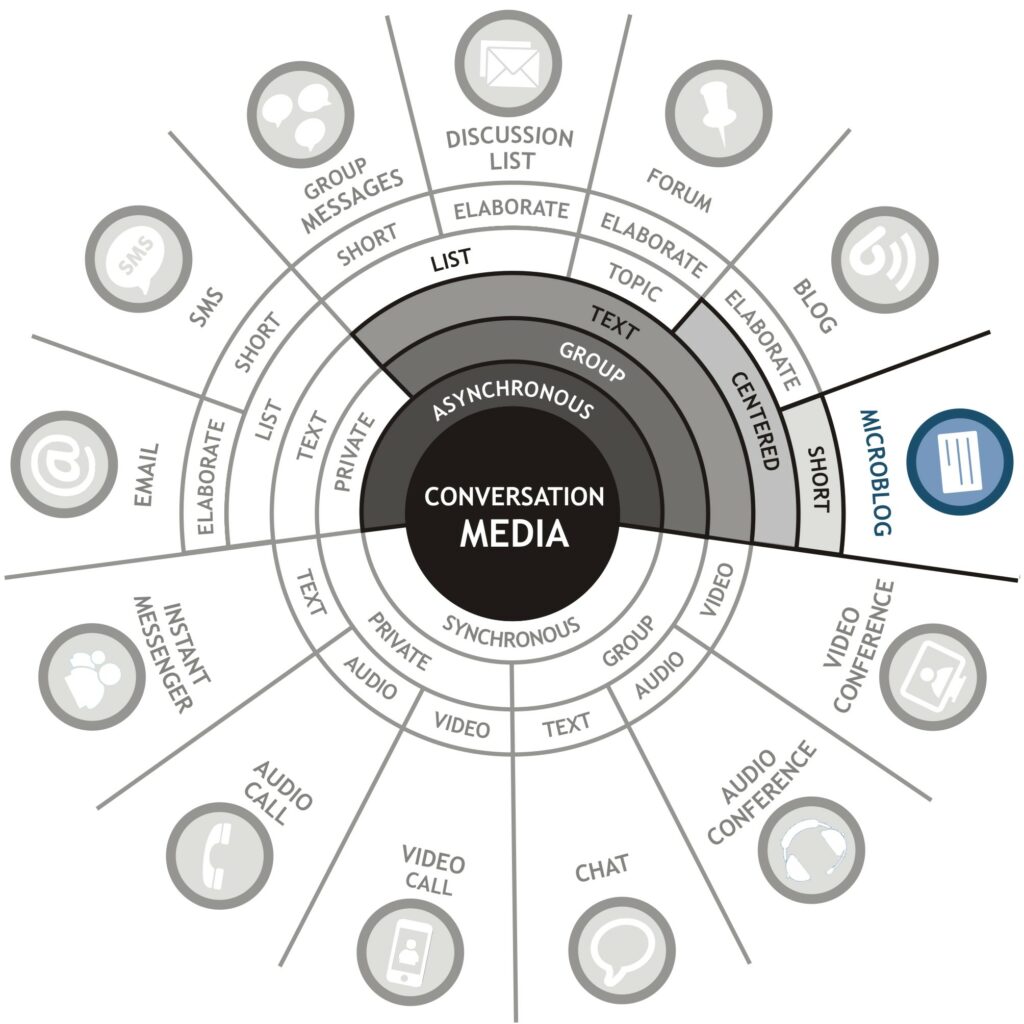
Following the same design adopted in this chapter’s simplified tree, the model in the shape of a mandala found in the beginning of the section “A model of internet conversation media” is another way of representing conversation media differentiation. This design has aided in the composition of our dictionary with the definition of conversation media.
The taxonomy proposed in this chapter is constituted by the criteria selected for media differentiation. As the chart shows, there aren’t two lines with the same values, because if there were, we would be missing a criterion to differentiate two conversation media. On the other hand, any other criterion added to this taxonomy would have been redundant, because all the media have already been discriminated. Therefore, we can conclude that the criteria we selected are sufficient to differentiate each of the media listed here.
We were also mindful of the taxonomy’s simplicity. The distribution of media over a spectrum, as presented in the previous section, in spite of allowing a more profound analysis, increases the complexity of the classification. For example, it’s interesting to find that conversation media are suitable for different group sizes, but that for our taxonomy it’s sufficient to differentiate between the media that enable private conversations (restricted to two people) and those that enable group conversations (among three or more people). If this dichotomy is sufficient for the differentiation of media, then we don’t need to adopt a more detailed categorization (duo, small group, medium group, large group, community and crowd), much less a spectrum.
It would be possible to propose another set of criteria for the differentiation of media, as long as it’s sufficient to discriminate them correctly. For example, we could suppose that the criterion “relationship among interlocutors” should be a part of this taxonomy, because it’s a relevant criterion due to the fact that it’s often used to differentiate mass communication media (unidirectional, one-to-all relationship) from conversation media (bidirectional relationship with different models: one-to-one, all-to-all, all-to-one). This criterion could replace privacy of conversation, since the relationship one-to-one is a synonym of it while group conversations are characterized by the relationships all-to-all and all-to-one. Observe, however, that the criterion privacy of conversation possesses only two vales (private and group), while the relationship among interlocutors possesses four possible values (one-to-all, one-to-one, all-to-all and all-to-one), unnecessarily increasing the number of categories in the taxonomy. Besides, the all-to-one relationship implies the centered organization of messages, and is thus redundant, because both mean the same thing.
As a matter of fact, we have identified that the criteria synchronicity of conversation (synchronous or asynchronous), privacy of conversation (private or group), and language form (text, audio and video) are the most relevant criteria for the discrimination of media. On the other hand, the criteria message organization and message size are necessary to discriminate specifically the asynchronous conversation media.
Several criteria found in the literature present some correlation, and, therefore, are not very useful to differentiate the media. For example, synchronous conversation media generally present messages that are shorter, more informal, with characteristics of orality, more natural, that better capture emotions, and more suitable for conversations that are private or established among a small group of people. On the other hand, synchronous conversation media generally present messages that are more elaborate, formal, literate, less natural, that better express the rational, and allow more people to participate in the conversation. Thus, criteria such as orality/literacy, richness and naturalness are seen here as a correlation, a consequence or a combination of other criteria such as synchronicity of conversation and language form.
Finally, a few other criteria found in the literature to classify communication media, such as the support for the communication and the system for recording messages don’t apply to this taxonomy, because all conversation media classified here have computing as a support and a digital recording system.
Classifying conversation services
Each conversation service implemented on a computing system has its peculiarities in terms of functionalities and interface, and it’s not always easy to recognize which conversation medium is being offered in a given service. In order to correctly identify the conversation medium implemented in a given system service, we have to analyze the characteristics of the conversation that takes place through the service. The criteria discussed in the previous section will guide the analyses.
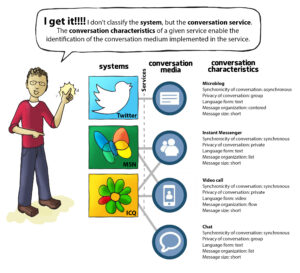
For example, let’s suppose that, when you used Facebook for the first time, you were trying to identify what is the conversation medium that the News Feed implements. At first sight, you could wonder if that service implements a blog, a microblog, a group message, a discussion list, a forum or what? In that case, you need to analyze the characteristics of the conversation according to the criteria determined in the previous section:
- Conversation synchronism. The Facebook News Feed was designed to establish an asynchronous conversation: the message sent by the user is stored and presented later to his friends (the moment one friend connects to Facebook). Even though this service can allow synchronous conversations (when the author of the post has hundreds of friends/followers, of which some are online and immediately comment on the recently sent message), the service was actually designed so that any friend can comment on the post at any time, not being necessary for them to be connected the instant that the author publishes it; thus, we understand that this service was designed to establish an asynchronous conversation.
- Conversation privacy. The Facebook News Feed was designed to establish a group conversation: the message sent by the user is visible to all friends/followers of that user. Additionally, this service allows the user to change the setting of the visibility of the message, indicating which group will receive it, with the option of: making it public, that is, accessible to anyone even if they’re not a friend of the user’s; making it visible only to specific people or to a more restricted group of friends (family, best friends, closest friends etc.).
- Language form. The Facebook News Feed was designed for the exchange of text messages. This service in reality allows the user to attach photos and videos, and also include emoticons in the text, but these multimedia files are complementary and have the purpose of enriching a conversation that effectively takes place through typed texts; we understand that text is the standard language form of this service.
- Message organization. In the Facebook News Feed, messages are organized as centered on the users. Each user has their own timeline, where they publish their messages (status). When they publish a message, friends/followers can comment on the post, and all comments are associated to the original post by the user, placing it as the center of that conversation.
- Message size. The Facebook News Feed induces the production of short messages. Even though there isn’t an imposition on the number of character per message, the interface and the functionalities of this service induce users to write short messages: the typing area initially contains only two lines of text, the text is simple (without formatting options) and, when a post has a long text, only the first lines are presented – all things that indicate that, in that service, short messages are expected.
Based on these five analyses, it’s possible to identify that the Facebook News Feed implements a microblog. This identification is made though any of the instruments presented previously:
→ If we move top down through the tree, criterion by criterion, we’ll arrive at the identification for the medium microblog:
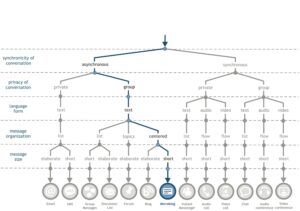
→ If we move inside out through the model, criterion by criterion, we’ll also arrive at the identification for the medium microblog:
→ Using the chart we recognize that the microblog is the conversation medium that meets all of the identified characteristics:
| MEDIA | CRITERIA | ||||
| synchronicity of conversation | privacy of conversation | language form |
message organization | message size | |
| asynchronous | private | text | list | elaborate | |
| SMS | asynchronous | private | text | list | short |
| Blog | asynchronous | group | text | centered | elaborate |
| Microblog | asynchronous | group | text | centered | short |
| Forum | asynchronous | group | text | topics | elaborate |
| Discussion List | asynchronous | group | text | list | elaborate |
| Group Messages | asynchronous | group | text | list | short |
| Instant Messenger | synchronous | private | text | list | short |
| Audio call | synchronous | private | audio | flow | short |
| Video call | synchronous | private | video | flow | short |
| Chat | synchronous | group | text | list | short |
| Audioconference | synchronous | group | audio | flow | short |
| Videoconference | synchronous | group | video | flow | short |
→ If we use the dictionary, we recognize that the microblog description is the one that better characterizes the conversation that takes place through the Facebook News Feed service:
 |
Microblog Meio de conversação assíncrona em que o autor divulga mensagens de texto curtas para serem comentadas por todos. |
The taxonomy presented in this chapter is useful in different scenarios. It aids the characterization and comprehension of different conversation media. It helps to design the functionalities of the conversation service so that a given conversation media can be implemented in a new system. It’s also useful to suggest conversation media that are yet to be culturally established – for example, by the diagram we can conclude that the video language form isn’t established as an important asynchronous conversation medium, even though YouTube already allows videos to be sent as answers to other videos. Several branches of the diagram are yet to be differentiated – each differentiation is an opportunity to explore conversation media that aren’t in common usage.
Clearing up a few misunderstandings
The conversation media identified here, characterized and differentiated by the elaborated taxonomy, constitute our starting point for the analysis of the evolution of these media. There are, however, a few issues that we need to discuss before ending this chapter. One of them is that sometimes it’s confusing to recognize and classify a system’s conversation service, as exemplified by a few Facebook services:
<Instant Messenger. When the friend is online, messages are exchanged just like in an instant Messenger (synchronous private conversation, short textual messages organized by list)
SMS. When the friend is offline, it’s possible to leave a message (asynchronous private conversation).
Group Messages. It’s possible to add several friends to a conversation and those who aren’t connected at that moment will later view the exchanged messages (asynchronous group conversation)
Chat. When there are several friends in the conversation and they’re all online, this service works as a chat (synchronous group conversation)
Email. The conversation is recorded in the service “Messages”, that works as an email, even allowing users to attach files.
*same conversation accessed by the service “Messages”>
On Facebook, an instant messenger is implemented on the window that opens when we want to talk to a friend online; this same user interface is used in order to leave messages for this friend in case he isn’t online, which characterizes a SMS service. Still on that same window we can add other friends to the conversation, which characterizes a group message service; and if all friends added to the conversation are online, it works like a chat. The record of the conversation that takes place on that window is accessed through the Messages service, which characterizes an email service. When you send a friend an email message through the Messages service, and this friend is online, the message appears on the window of the instant messenger service, offering to interlocutors the interface for synchronous conversation. To Facebook, the important thing is for users to establish conversations with their friends within the social network, regardless of which service they use. Users can use one interface or another and Facebook will perform the service that is appropriate depending on the conversation context – the interface remains the same, but the service changes whether the friend is online or offline and whether the conversation takes place among two friends or several. The difficulty in recognizing conversation services on Facebook is due, in part, to the necessity of differentiating the service from the interface. It would be easier to recognize that those are different services if each of them presented a distinct interface, but that’s not the case. What we want to emphasize with this discussion is the dissociation between the conversation service and the user interface: there are cases in which the same service is accessed through different interfaces, and the same interface gives access to different services. This does not invalidate the idea that the unit for analysis and classification is the conversation service implemented in a system, even if it is necessary to recognize that on one single interface two or more conversation services can be implemented.
Another recurring misunderstanding has to do with the terminology adopted to characterize a few conversation services. The Gmail system labels as “Chat” what we recognize as being an instant messenger service, and other systems also label as chat what we recognize as being a group messages service – are those abuses in terminology? As presented and discussed in this chapter, from our point of view, these are different media: instant messenger, SMS, group messages and chat. The misunderstanding takes place because these media are similar and, in our taxonomy, are differentiated by a single characteristic, as shown below:
| private conversation | group conversation | |
| synchronous conversation | Instant Messenger | Chat |
| asynchronous conversation | SMS | Group messages |
Since we recognize those as different media, yes, we consider it an abuse in terminology to call a chat what is, in fact, characterized as an instant messenger.
| ← Previous page 1. CMC (Computer-Mediated Conversation) |
Chapters (Index) |
Next page → 3. Evolution |