Computing Mediated Conversation
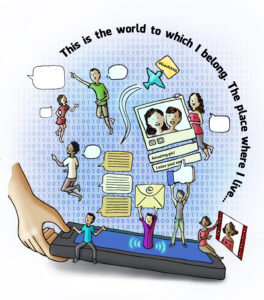
We live in a time when our society is going through deep changes that are influenced by the development of digital network technologies. Using different devices and systems, we can talk to anybody practically anytime and anywhere, with the exception of a few places that remain disconnected from our network society. Connectivity is so widespread that the distinction we made in the beginning of the century between online and offline moments is no longer possible. Now, we are connected all the time.
Network societyManuel Castells, in the book Network Society (1996), released when the internet was beginning to be opened for commercial use, already stated that we’re going through a social revolution caused by the ever increasing use of computer networks. Digital information and communication technologies, ever since de 1970s, have been transforming in a global and profound way the several aspects of human relations: work, economy, culture and space-time. |
It’s hard, particularly for younger people, to imagine that until a few decades ago, the exchange of information took days to be completed. If we wanted to exchange texts with a friend or distant relative, we needed to use the postal service, and it took days for the letter to be received and days for us to get the answer back; sometimes, this interaction would take weeks. We had practically only one resource to communicate faster: the telephone. In order to keep in touch with what was happening in the city and the world, we had to resort to mass communication media: radio and television networks or the printed press, such as newspapers and magazines. Our opinion about events was restricted to friends that were physically close to us (unless we were reporters, columnists or were being interviewed by a mass communication medium). Any information would only circulate after being filtered by an editor.
Today, we are never alone; we take everyone we know in our pocket, and can access them with a click of our smartphones. All we need to do is open Facebook, for example, in order to see countless messages, sent every instant, about many different kinds of topics. We know who is available for an immediate conversation. If we like a message, we leave comments on it and replicate it to our friends. We take part in communities and groups in order to discuss our favorite subjects and thus interact with a circle that is no longer restricted to those that are physically close. We have ceased to depend on mass media to get news: now, we receive it from friends or friends of friends who witnessed the facts up-close. We are content senders when we post a comment. We talk to crowds without intermediaries.
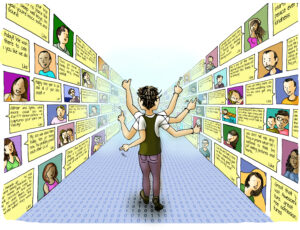
Conversations now take place through the several conversation services that are implemented on computing systems that we use to interact, to have relationships, to give opinions, to inform, to register thoughts, among other experiences. We exchange email messages using systems like Gmail and Hotmail, we publish our status on Twitter or on our Facebook timeline, we talk to friends via WhatsApp or SMS messages, we leave comments on the blogs of the main news portals, we discuss our favorite topics through discussion lists and forums, such as for example Facebook groups, Yahoo Groups or Google Groups, we talk looking into the eyes of a distant person using video calls in systems such as Skype and FaceTime. Contemporary systems, notably social network systems, integrate several conversation media that have been popularized in the last few decades.
Conversation media are promoting changes in several aspects of society. The systems that implement these conversation media allow message exchanges between consumers and companies; students, teachers, parents or guardians; voters and politicians. Given the necessity to understand the new practices that are emerging in our society, computing systems and conversation media have become objects of research in several different fields of knowledge. We need many outlooks and perspectives, different focuses and research approaches in order to better understand the phenomena that are emerging in cyberculture, which is our contemporary culture mediated by digital network technologies.
Communication technologies and the cultural history of mankind
Communication technologies change our relationship with knowledge and the way we understand the world; they change the way we perceive each other and ourselves, and the way we are connected to each other as a society. The cultural and social implications are so profound that the history of mankind can be organized according to the emergence of communication technologies. Pierre Lévy, in his book Les technologies de l’intelligence (1990), highlights three main eras of mankind: orality, literacy and informatics.
Imagine how our ancestors managed to understand each other when human beings lived in caves. In order to obtain a common understanding, mainly necessary to perform group activities, they had to resort to face-to-face conversation, which requires interlocutors to be present in the same place and time and requires the senders and receivers of the information to share the context of the conversation. In an oral society, characteristic of pre-historical times, all culture and knowledge depended on individuals and places being remembered.
With the development of the alphabet, emerged the literate society. Writing, which was developed by several ancient civilizations, changed our relationship with knowledge, which became independent from the memory of the people, the situation, the place and the time. The written text is an extension of memory, which keeps the message outside of context and makes it universal. This universality was culturally absorbed by civilizations and was the foundation of science and philosophy. The printed press allowed the mechanization of the alphabet, and the general distribution of texts led to the explosion of learning, which was essential for the establishment of science as the dominant mode of knowledge.
After that came the electronic media of communication: radio, cinema and television. Messages were being received by millions of people, which led senders to elaborate messages that would reach everybody; in order to do that, content had to demand a minimum interpretative capacity from the part of receivers. These media are based on spoken and visual messages and, without records that are reminiscent of the printed press, they are more similar to the culture of an oral, almost tribal society, but in a global context. This mass media society constitutes a Global Village, according to McLuhan. In this society, spectators receive messages passively, are kept isolated, don’t participate actively and are never the protagonists.
McLuhan’s Global VillageIn the books The Gutenberg Galaxy (1962) and Understanding Media (1964), Marshall McLuhan presents his vision that people, due to the fact that they could communicate with anyone, anywhere in the world, would come to live in a sort of globalized tribe, the Global Village. This concept was based in the popularization of television and, in spite of the fact that it was proposed before the development of computer networks, is considered a prediction of the release of the internet – that’s why McLuhan was called the “patron saint of the internet” by Wired magazine. |
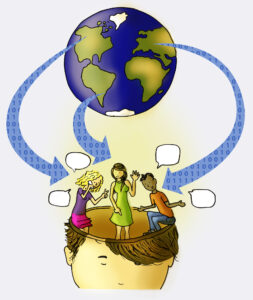
The development of computing, based on the binary numeral system used to represent any content, had allowed the convergence of means of communication – text, image, audio and video have converged to this multimedia support. Digital content, insubstantial and interactive, has changed writing and reading. Computer networks have established cyberspace, which brought us cyberculture. The distribution of messages is instantaneous and ubiquitous; it’s easy to retrieve and edit them; and a text can have several authors or none. The text is fragmented and is no longer characterized as a finished product. Unlike universal writing, the message is contextualized in virtual communities, is personal and relates to other messages as a result of the conversation among interlocutors. Interlocutors interact in real time, are no longer isolated in an immobile silence like the one demanded for reading a book and don’t have the characteristics of a passive audience like the ones of the spectacles promoted by mass media.
The act of communicating is not only more popular, but, more importantly, it’s the activity to which users devote more time, surpassing by far the hours spent in other activities such as, for example, the search for information. In the US, each user uses Facebook an average of 7 and a half hours a month, much more than the monthly time dedicated to other systems such as Google, where the average use is of less than an hour a month.
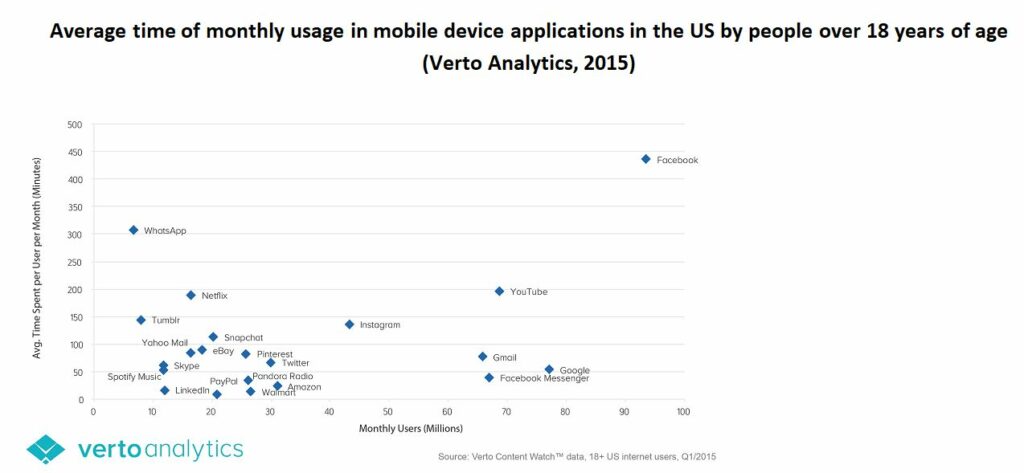
This preference is what characterizes contemporary society. These data confirm the necessity of better understanding conversation systems and internet conversation media.
Conversation instead of Communication, Computing instead of Computer
Before we finish this chapter, we would like to explain the terminology adopted in its title and throughout the book, because we have brought up to date the terms “communication” and “computer” from the classic denomination Computer Mediated Communication (CMC), which refers to studies about the phenomena that have emerged due to the use of computing systems to aid human conversation, focusing traditionally on the technical (computing systems and services), linguistic (the language that emerges in these media), cultural (new practices) and social (establishment and changes of social relations) aspects.
“Communication” is a very comprehensive term and also traditionally associated to mass communication media, where a sender sends a message (televised content, a radio show, a printed news story) to several receivers/spectators, establishing a unidirectional communication made by diffusion and without the interaction of the subjects involved in the process. But the term “conversation” is traditionally associated to face-to-face conversation, to dialogue, to the interaction established between interlocutors – subjects are at the same time senders and receivers of the messages they exchange. Even though in the past century conversation could already be mediated by technologies such as the telephone and the letter, computer networks boosted this interaction. Therefore, in this book, we preferred to adopt the term conversation to better characterize and restrict the object of our study. It’s important to remember that classic studies about CMC also focus on internet conversation media, investigating the phenomena that emerged from these media, such as the absence of face-to-face interaction, asynchronous conversations, anonymity, privacy, virtual communities, conversations that involve crowds, among others.
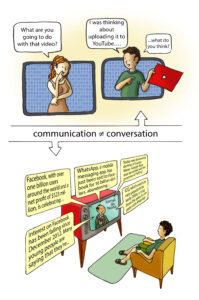
“Computer” is the other term in CMC that we felt the need to modernize, adopting the term computing. The computer – originally conceived to make calculations and later to process data – since the development of computer networks has become an important technology at the service of human conversation and interaction; the most important of our century, in fact: the one that is present throughout the globe and that is causing profound changes in our society. However, the term computer currently does not comprehend the several different digital technologies that make conversation possible.
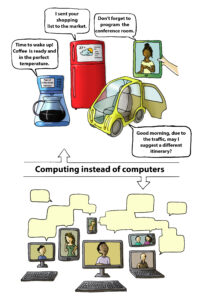
A smartphone is not usually recognized as a computer by the average citizen. Even harder than that is recognizing smart objects as computers; they’re generally seen as the objects they are: Smart TVs, GPS, digital blackboards, etc. The term computer is usually associated with the equipment that is used for the specific and exclusive purpose of computing, such as the mainframe, the desktop, the laptop and the tablet. Computing, however, doesn’t just take place in these specialized equipment; it’s also present in electronic toys, robots, microwave ovens, smart refrigerators, home automation and anything else that electronically processes digital data. The contemporary tendency is ubiquitous or pervasive computing, that is, the Internet of Things. Thus, we prefer to adopt the term computing, because our study isn’t restricted only to conversation media that were implemented in what is traditionally known as a computer; it also deals with conversations that take place through smartphones or smart TVs, and probably applies to any other electronic equipment used to establish conversation between people.
| ← Previous page Introduction |
Chapters (Index) |
Next page → 2. Taxonomy |