
How do conversation systems relate to each other and the sociocultural environment?
How do conversation systems relate to each other and the sociocultural environment in which they are inserted? In order to investigate the interaction among systems, we need to measure the populations of users of these systems, which, if compared, will allow us to identify the most popular systems during a given time. For example, the variation of the population of systems that implement the same conversation medium makes it possible for us to investigate the competition among these systems. In this chapter, we present metrics and laws that explain the interactions among conversation systems in their ecosystem.
EcosystemIn Biology, an ecosystem is the system where given populations of animals, plants and bacteria live and interact among themselves and with the external factors of the environment, such as water, sun, ice and wind. Examples of ecosystems are: Desert, Forest, Lake and Urban ecosystems. |
Measuring and comparing the popularity of systems
Systems that implement a given conversation medium form an ecosystem that we recognize by the name of market. Studies about the user population of a system in comparison with that of its competitors are made, and they enable us to characterize the popularity and market share of each system. The popularity of a system translates into its sociocultural importance, and following its variations throughout time allows us to analyze the relationship of the system with the environment in which it’s inserted. As a result of these studies, the market share of a system in a given period, place or niche is represented as a percentage of the market as a whole.
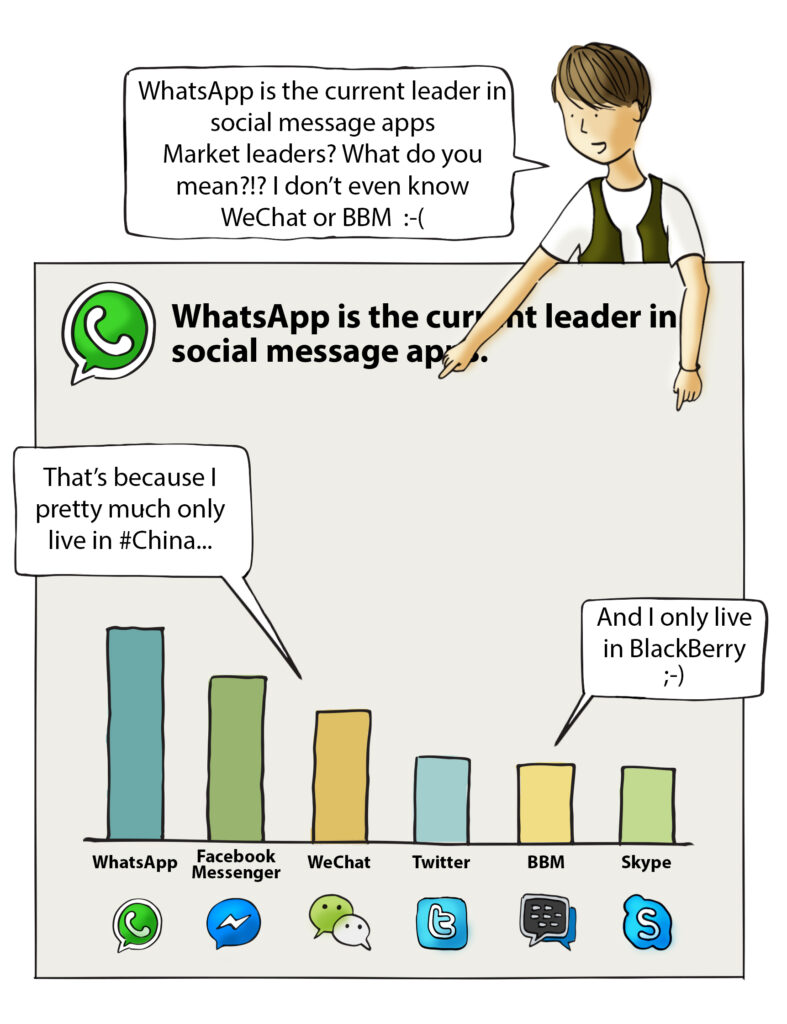
In many markets, the product or service is sold to the consumer and the total number of sales is used to calculate the market share. This metric makes no sense in the market of computing conversation systems, because these systems are usually free. The share of a conversation system in the market is calculated by its adoption. This share must be measured by the systems that are most used, not the ones that sell more.
Establishing which systems are the most used or the most popular is not a trivial task. For example, the metric used to determine the number of users of a given system is generally the number of people who are registered in it. However, we know that many of these people only register to get to know the system, use it once or twice and then never go back. But the accounts of those users remain and, therefore, the number of registered users only goes up, never down. Users don’t close their accounts in the system, which makes it impossible to establish a decline in its use. We need another metric to analyze the interaction among competing systems, so that we can find what will allow us to identify which systems are becoming popular and which are declining in a given period. Some alternative metrics are seeing how many people use a system frequently and how many users are connected at the same time, as we will discuss in the following sections.
Level of usage: registered user to heavy user
It’s common for a person to register in several systems, but only effectively use one service for each medium. That’s why metrics based on the number of registrations in the system or the number of visitors to the system’s website can’t really demonstrate how many people actually used this system in a given period.
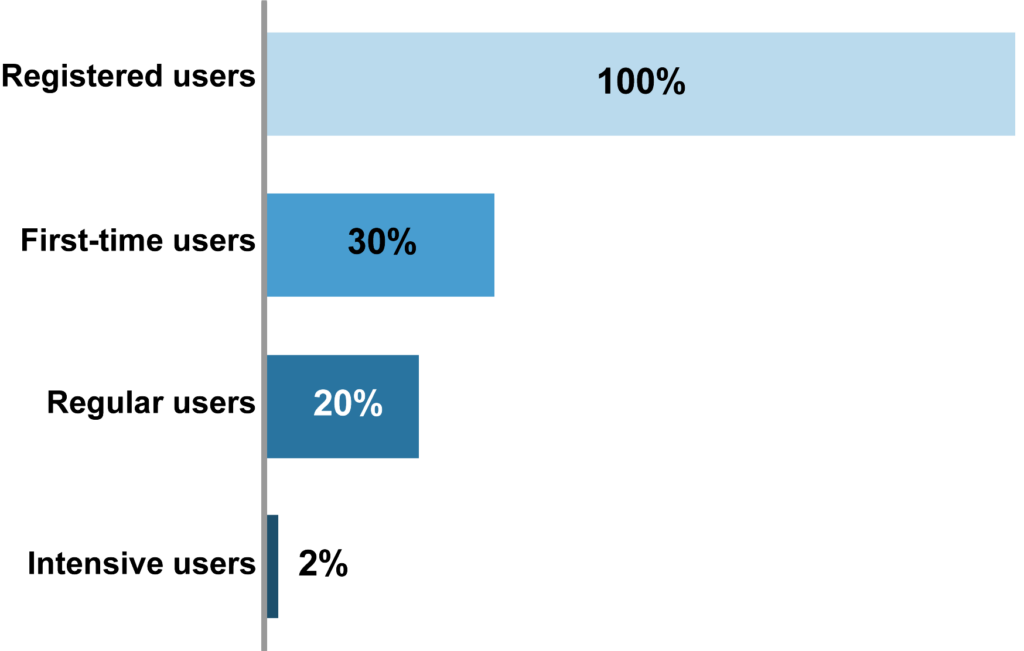
One of the ways of making more precise studies about system popularity is measuring the number of regular (or active) users, as exemplified by the funnel diagram and the cohort analysis. Instead of measuring the total of registered users, it’s more revealing to measure the number of people who used the system in a given period, for example, the previous month.
Funnel Diagram (Porter, 2008) and Cohort Analysis (Ries, 2011)The Funnel Diagram is used to establish the different profiles of system users. For example, among people who are interested in the system (registered users), only a few use the system once (first-time users). Among people who use a system once, only a few use it frequently (regular users), and few become passionate users (intensive users). This analysis reveals the different levels of usage of a system, even though each system has different percentages of users in each category.
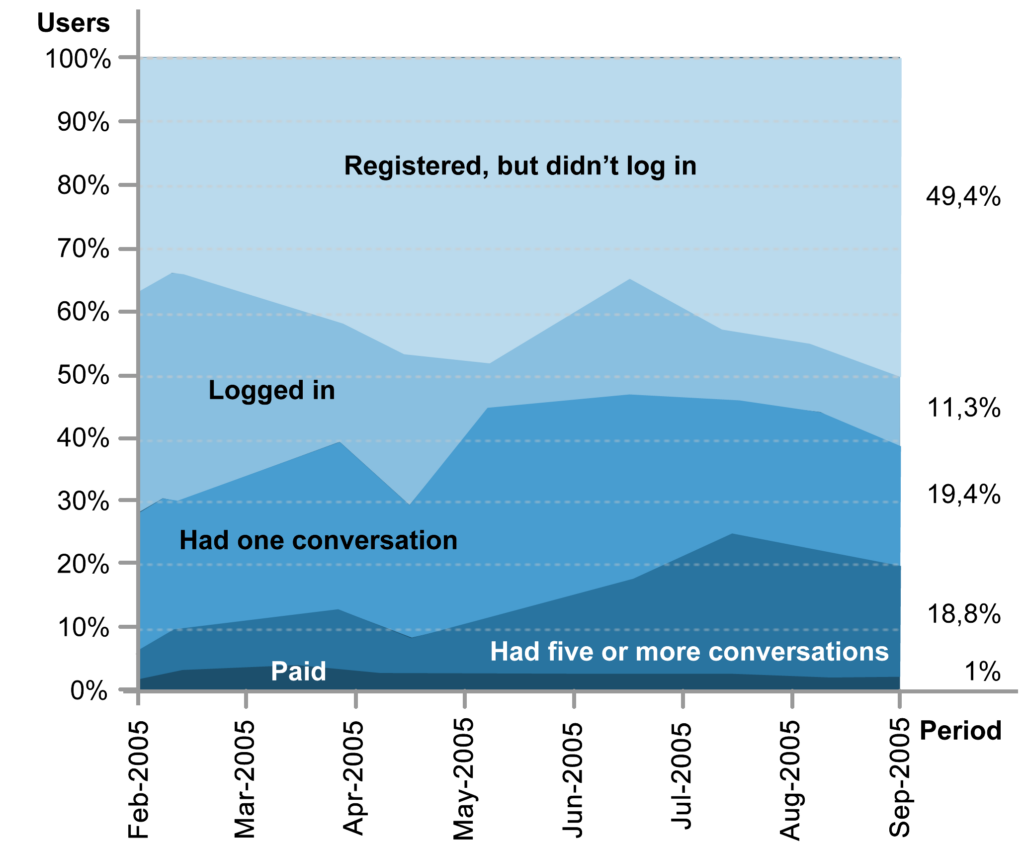
The Cohort Analysis consists in separating users by groups (cohorts) that share certain characteristics or experiences. This analysis was made by the developers of a company called IMVU, who grouped users in the following cohorts: registered, but didn’t log in (should we really call these people users?); logged in, but didn’t participate in a conversation (also not effective users); had at least one conversation (actually used the system); had five or more conversations (regular users); paid for the use of advanced features (intensive users, who recognized the utility of the system to such an extent that they became paying users). The behavior of that system’s users was followed for eight months, according to data presented in the following graphic.
Initially, the company was interested in having more users become paying users, but that didn’t happen in the period analyzed. However, as those months went by, more users began having more frequent conversations through the system, which increased the number of intensive users. This reveals that there was an increase in the usage of that system, even though, during that same period, the percentage of registered users that didn’t actually used the system also increased. This seems like a contradiction, but the graphic reveals that it’s possible (because there was a decrease in the group of users that only logged in and didn’t establish a conversation through the system). |
In order to better characterize the culture of use of conversation systems and, consequently, make market share studies, this other metric – the number of regular users (that is, those who accessed the system in a given period or even sent messages in a given period) – is more adequate than the total of users registered in each system.
Entire market: absolute quantity x relative quantity
It’s very common for companies to present the growth of users of their system throughout the years. However, if we compare this growth with the increase in the number of internet users in the world during that same period, the growth in the number of a system’s users may not be that expressive, or there may even be a relative decline, as illustrated by the IRC case detailed in the following board.
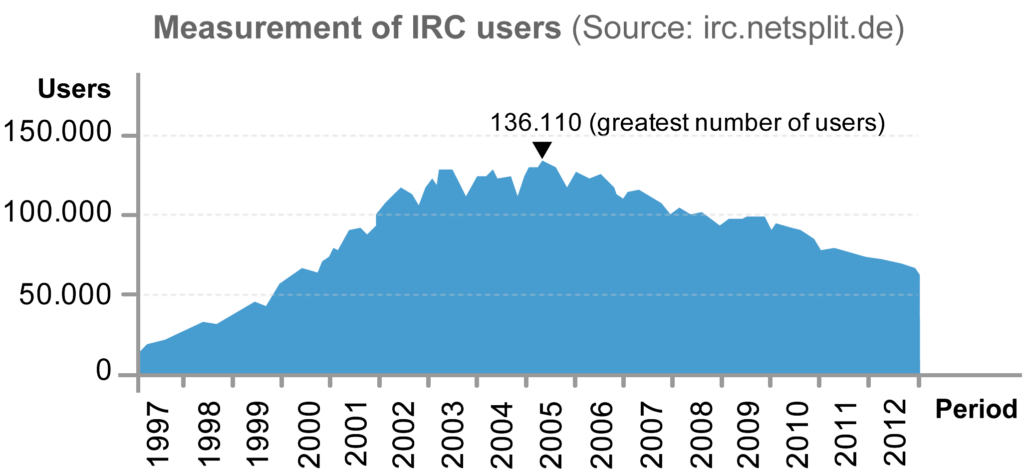
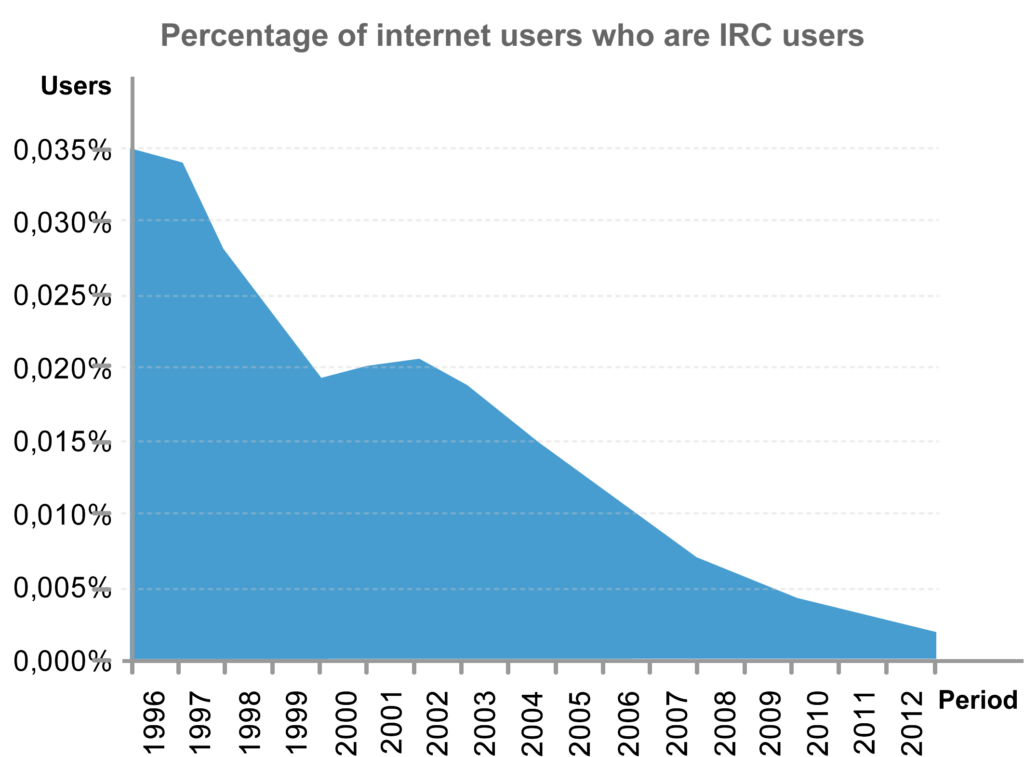
The IRC case: the illusion of popularity increase once we consider the number of online usersIf we analyze the number of online users of IRC (Internet Relay Chat) between the years 1997 and 2012, our first interpretation will be that its popularity reached its peak in 2005, when it had the greatest number of online users, and that, from this year on, it began to decline.
However, this is the wrong interpretation, because the graphic only shows the absolute number of IRC users. When we consider these users in relation to the total of internet users in each year (Internet World Stats, 2012), we observe that the decline in IRC’s popularity was already very clear in 1997.
In terms of popularity and, consequently, sociocultural importance, the peak of IRC was in the mid-1990s, and not 10 years later as may seem by the absolute number of users. Even if the number of IRC online users increased between 1995 and 2005, in that same period the number of internet users, all potential IRC users, increased much more. Therefore, IRC was much more relevant in the market in the mid-1990s than in 2005. |
Identification of systems that constitute a market
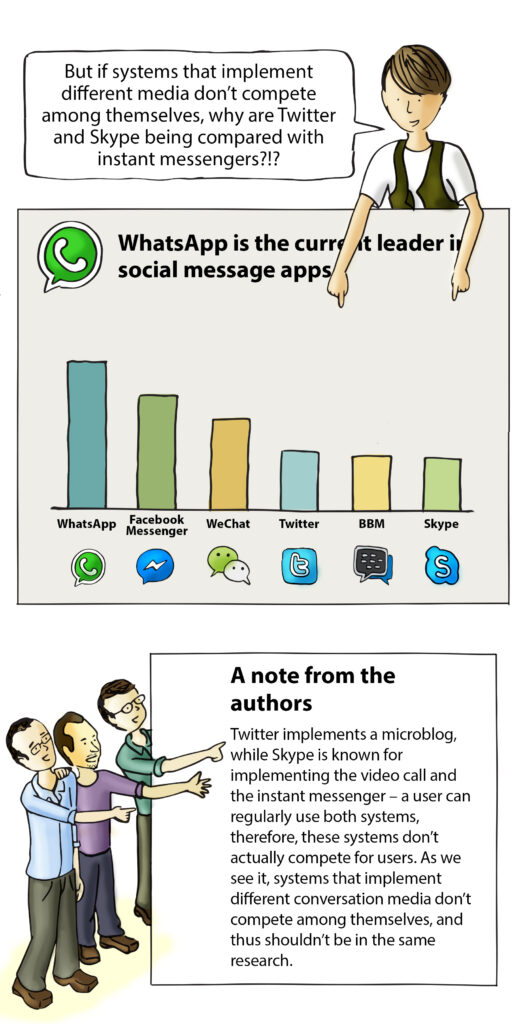
In order to make a market research, we need to identify which systems have a share in that market. We consider that a market is formed by the systems that implement a same conversation medium. However, a few market researches inadvertently include systems that implement different media, such as, for example, those that compare Skype and Twitter. To us, these systems don’t compete; they belong to different markets, and therefore should not be included in the same research.
We had a difficult time finding good market researches. Some adopt inadequate metrics, others mix systems that don’t compete. We hope this book will help clarify this. Good researches are necessary to investigate the relationship among systems more precisely. In spite of this difficulty, in the next section we establish laws and illustrate them with the data we found until publication time.
Laws that govern the relationships among conversation systems
The evolutionary perspective presented in this book has led us to elaborate laws that explain how the interaction among systems that implement conversation media occur. In Biology, laws of population ecology were developed to explain the interaction of populations of one species of living being with its environment and to identify the variation in the size of these populations throughout time and space.

Laws of population ecology of living beings (Haemig, 2011)The basic question that guides the studies on population ecology is understanding which factors influence the size and stability of populations. Studies about populations of living beings are based on nine population ecology laws. These laws determine when a population decreases or increases in size, what are the consequences of these variations, what limits population growth and how are the relationships among predators and prey. |
In order to explain how conversation systems compete for users, we have elaborated three laws: systems that implement a same medium compete among themselves; systems that implement different media don’t compete among themselves; and conversation systems survive in different niches of the market. These laws were illustrated with data obtained from market share research.
Systems that implement a same medium compete among themselves
Competition among systems occurs because, when a user adopts a given conversation medium system, they stop using others that implement the same medium. For example, if you use Gmail to send email messages, you probably don’t use Hotmail or some other system with the same purpose. If you regularly use Facebook’s microblog, you probably won’t be interested in using another microblog system. As a consequence, there is a competition among systems that implement a given medium to have the largest possible market share. This phenomenon is similar to the competition among living beings of a same species.
Competition among living beingsAmong living beings, competition occurs when individuals of a same species or of different species fight over resources such as food, territory and sexual partners, among others. Competition favors the life forms better adapted to the environment at that moment and leads to the extinction of the less adapted. |
One consequence of this law: if a system is becoming popular in a short period of time, while the number of internet users hasn’t risen significantly in the same period, then competing systems are losing users. This is what happened, for example, when MySpace users migrated to Facebook. The number of users is limited, and that’s why similar systems that implement the same conversation medium compete for them. Another example is the migration of MSN users that started adopting Facebook’s instant messenger, according to the research presented in the following board.
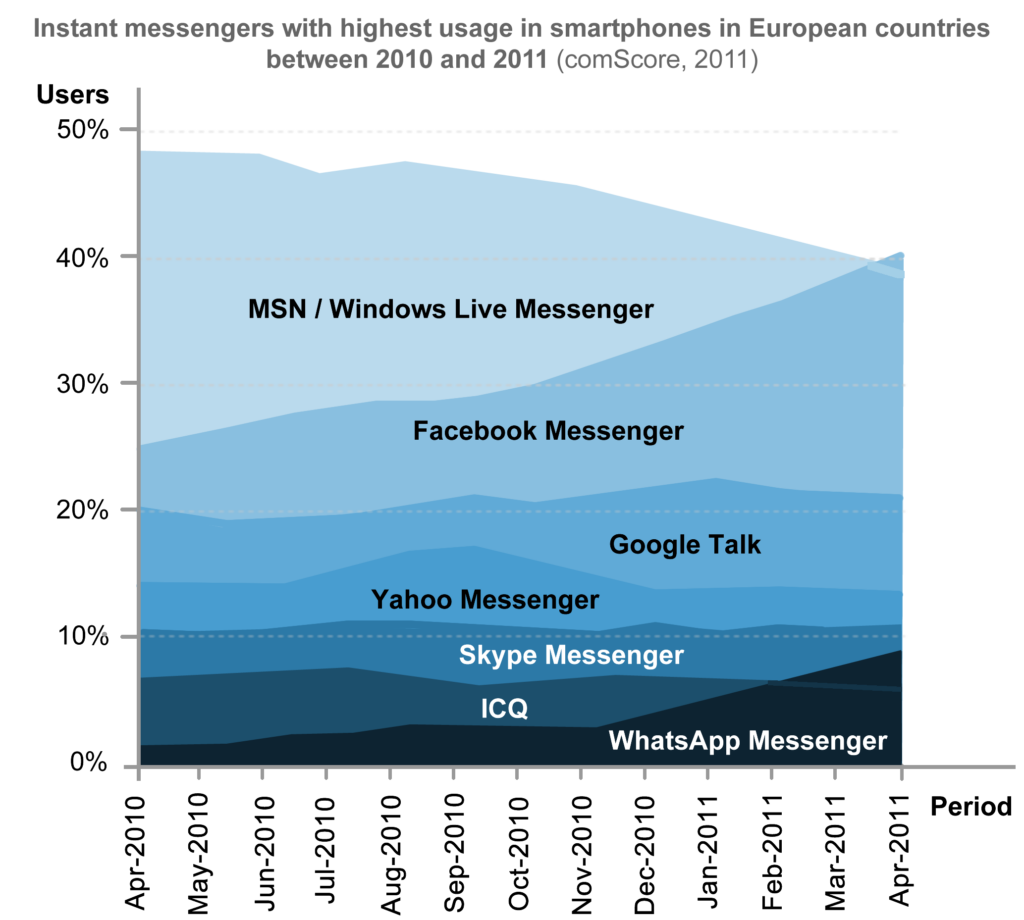
Between April 2010 and April 2011 there was a great increase in the number of users of Facebook’s instant messenger, and a great decrease in the number of users of MSN Messenger, while the popularity of the remaining systems that implement that same medium practically remained stable. This research reveals the competition that was taking place mainly between these two systems and the phenomenon of user migration between them. In this research we can also identify the beginning of the rapid ascension of WhatsApp, which in 2014 became the leader of this market. |
Systems that implement different media don’t compete among themselves
Different media serve different conversation purposes. For example, one person can use one system to make video calls and another system to send instant messages. Systems that implement different conversation media are used concomitantly by the same person and, therefore, these systems don’t compete among themselves for users.
Different systems that implement the same conversation medium survive in different niches
A conversation system isn’t always popular all over the world, but it can become popular in a specific niche, that is, be a success in a given region, age group or platform (web, desktop or smartphone). This is similar to the geographic isolation that results in the speciation of living beings
SpeciationSpeciation is the evolutionary process responsible for forming species of living beings. It begins when a subpopulation of a species becomes geographically isolated and thus alters its behavior and ecologic niche. When it becomes reproductively isolated from the rest of its species and undergoes cumulative mutations, the subpopulation’s genotype and phenotype are altered. As a consequence, a new species emerges. |
The popularity of a system varies according to the locality of the user. Due to cultural differences that include, for example, the language, the leading system that implements a given conversation medium may vary in different countries. Since a social group needs to share the same system in order to have a conversation, geographic and cultural distance can lead to the success of different systems. So, a system that is the market leader in one country can be unknown in another, as exemplified by this 2008 research about the most used instant messengers in Brazil and Russia.
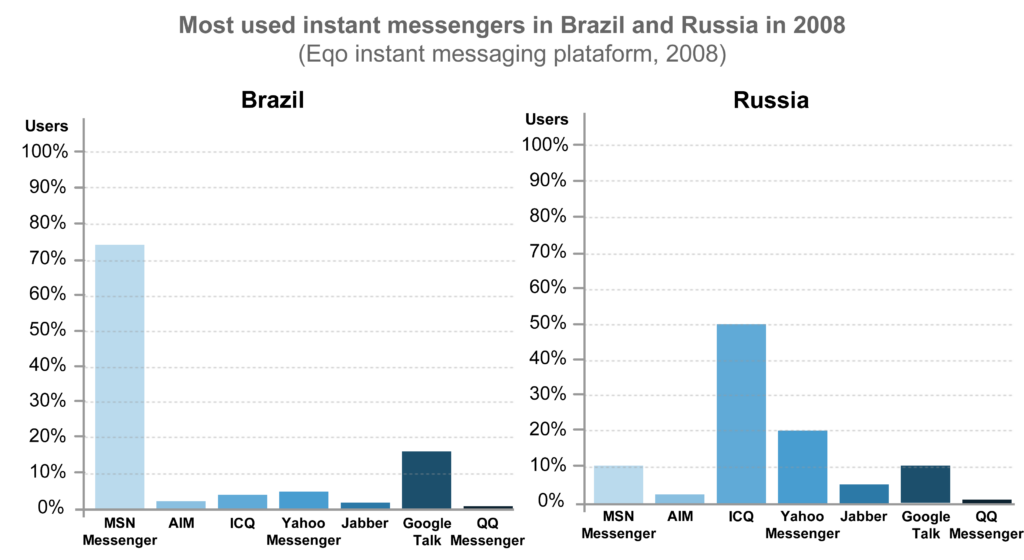
This analysis of the popularity of instant messenger systems in different countries, made in 2008, reveals that in Brazil the MSN Messenger system held a 70% market share and that in Russia ICQ was the most used system, with 50% of users. |
The popularity of a system also varies according to age group. For example, a system can be very popular only among the younger set.
Percentage of age group of email systems users
|
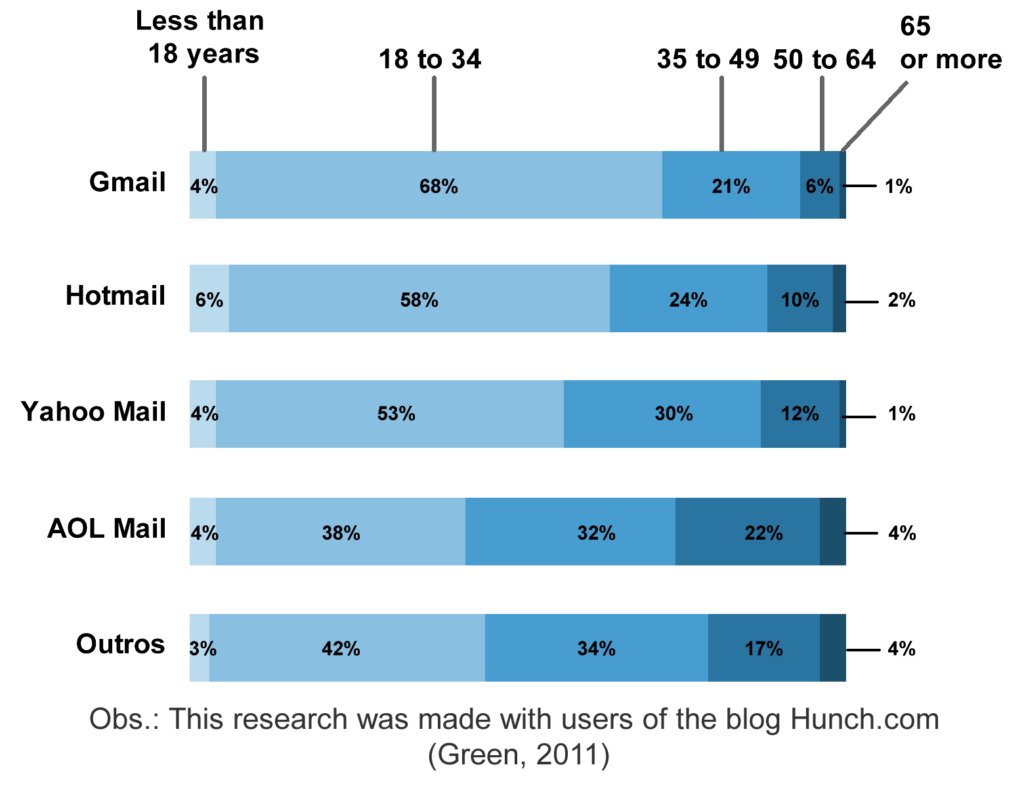
A conversation medium is implemented in systems based on different platforms, such as web, desktop and smartphone. When a new platform is released and is adopted by a large number of users, several systems meant for that platform are also developed, and a new market niche is formed. For example, the introduction of smartphones based on operating systems such as Android and iOS resulted in several new systems, among them WhatsApp, whose characteristics attracted a public of teenagers who changed from Facebook’s group conversation service to this new app, which became the leader in this smartphone market niche, while Facebook’s service is still the leader in the desktop market.
… other laws?
The laws of population ecology of living beings were proposed by different researchers, in different years. We believe that other researchers will identify other laws about the ecology of conversation systems. At this time, we don’t have reliable data to evaluate the following theoretical conjectures, which we elaborated as possible future laws:
- Conversation media compete among themselves. We suppose that the development of a new conversation medium will compete with a similar existing medium. One example of this is the competition between the microblog and the blog: in the last few years, the number of people who use microblog services has increased, while the number of people who use blog services has decreased, but we still haven’t found reliable data to evaluate this speculation. These data could also exemplify this proposed law: the popularization of instant messengers on smartphones has decreased the use of SMS and chat services; and the recent popularization of group message services, such as the one implemented on WhatsApp, promotes a decrease in the use of microblog services, such as the one implemented on Facebook.
- Conversation media survive in different niches. Just as with systems, some conversation media are preferred in given localities, age groups or platforms. For example, emails are preferred by older people, with 35 years of age or more, who favor elaborate and formal messages, usually sent in a work-related context; while younger people prefer to establish conversations in a group through instant messages, which are short and informal and a get faster responses.
- The development of a new platform promotes a great growth in the development of conversation systems. New platforms offer opportunities for innovations in conversation media. For example, computer networks allowed conversations among more people, the web allowed conversations independently of the access computer, and smartphones allowed conversations in different places and moments. The new possibilities that arise with the platform promote the development of several innovative solutions.
| ← Previous page 4. Selection |
Chapters (Index) |
Next page → 6. History |