|
Internet conversation media: an evolutionary perspective from email to social networks Introduction |
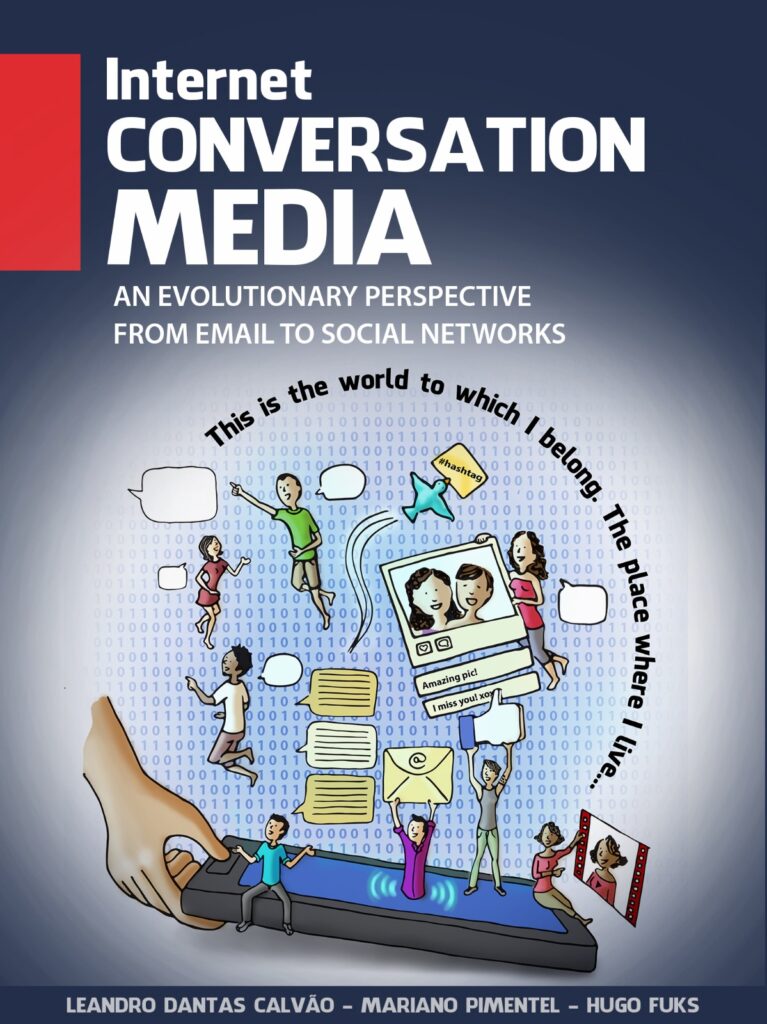
This book discusses the evolution of Internet communication media: email, mailing lists, discussion forums, instant messengers, chat, SMS, group messaging, blogs, microblogs, videoconferencing, video calls, audio calls, and audioconferencing. It draws an analogy with the evolution of living beings: as if systems were living beings, culture were the environment in which systems live, and users were the resources for which systems of a given species compete.
Communication systems and media evolve like any other technology, with evolution being the result of innovations and influences from previous technologies. This perspective contrasts with the creationist view that proposes that a technology emerges as an invention of a solitary genius, who does not take into account many influences in its design. By understanding how media and systems evolve, it is possible to better understand the state of the art, perceive trends, correctly identify media and analyze the competition between systems that implement the same media. The evolutionary perspective is important to avoid some conceptual errors such as those we have become accustomed to hearing in the media: “So-and-so is the father of email” (this statement reflects the creationist view) or “social networking systems will kill email” (these media do not compete with each other).
Regarding the evolution of conversational media, we developed concepts, laws, models and methods that answer fundamental questions such as: what are the Internet’s conversational media, how do they evolve and differentiate themselves, why do some systems that implement conversational media survive while others become extinct, and how does competition between them occur? For the discussion, the technological and cultural aspects that influenced the evolution of conversational media over time were considered.
The book is organized into the following chapters:
- CMC (Computer-Mediated Conversation): we discuss communication technologies and the cultural history of humanity, emphasizing how the conversational means of the internet are transforming our contemporary society;
- Taxonomy: we identify the means of conversation on the Internet, the criteria that make it possible to differentiate them, and how to classify the conversation services implemented in computer systems;
- Evolution: We discuss how conversational media evolve;
- Selection: we characterize how the selection of systems that implement conversational means occurs, aiming to explain what leads to the success or failure of a system;
- Ecosystem: we address the interactions between systems and the environment, and present population studies of the systems;
- History: from the evolutionary perspective presented in the chapters of this book, we (re)tell the history of conversational media.
Who might be interested in this book?
- Researchers, professionals and students of cyberculture. This book is intended for all those interested in the phenomenon of cyberculture, which is characterized as an interdisciplinary scientific-cultural field of studies on the phenomenon of contemporary culture mediated by networked digital technologies, including systems and means of conversation.
- Computer systems developers. We discuss the functionalities of the systems and the conversation characteristics of each medium with the aim of supporting the design of conversation services.
- Researchers and historians of the evolution of technologies. This book proposes a conceptual framework that supports the telling of the history of conversational media and computer systems from an evolutionary perspective.
- Linguists and scholars of new textual genres emerging in cyberculture.
Licensing:
Attribution and non-commercial use. This book, including all chapters and images, is licensed under a license that allows others to remix, adapt, and create derivative works based on this work, but its use for commercial purposes is prohibited. New works must include a mention of this book in the credits.
Webbook layout: Diogo Ferreira de Freitas
| Chapters (Index) |
Next page → Introduction |