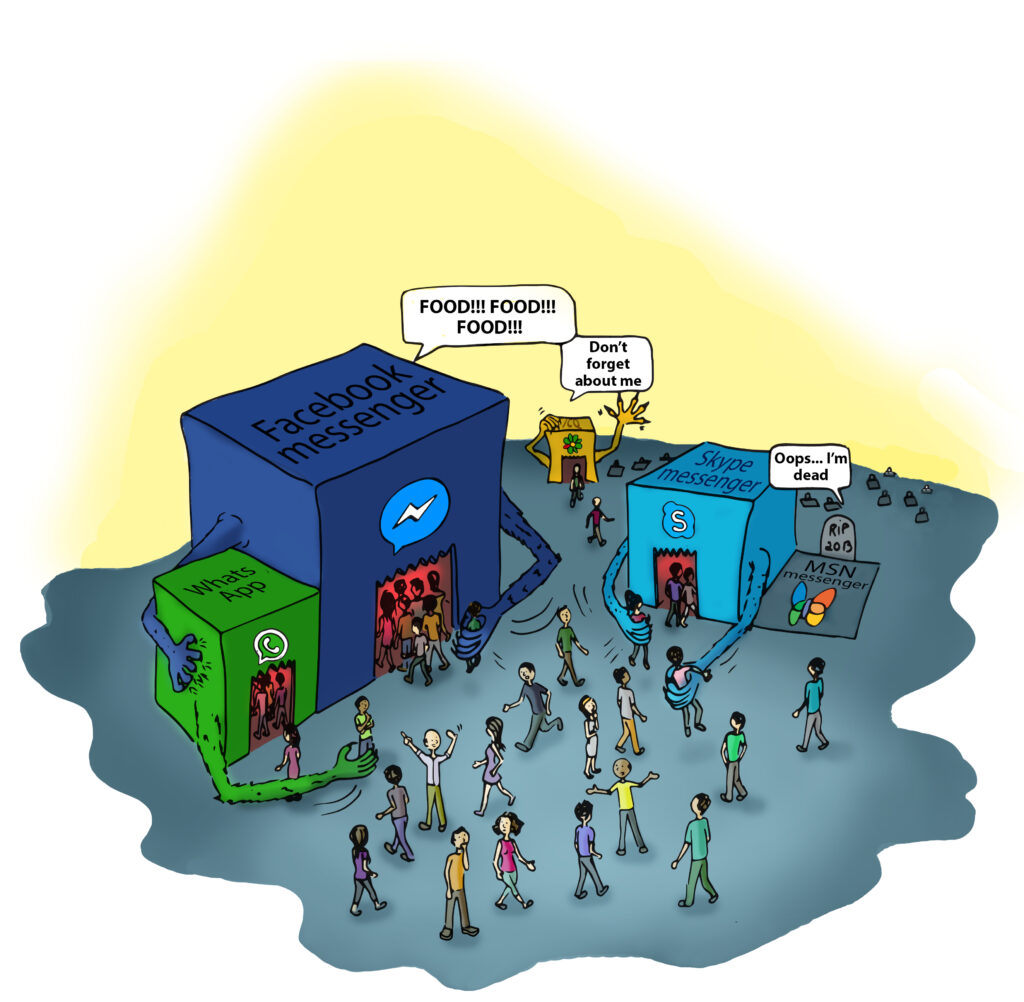
Careful! You’re being used every day and might not even know it. We consider ourselves users of conversation systems, but who is actually being used? These systems fight over us and we’re becoming more and more addicted to them. How many people can spend a whole day without being used by one of these systems?
If we brought a person from the 1950s to our times, they would immediately notice that there are a few differences between then and now. Today, we spend several hours a day interacting through systems like Facebook and, due to the conversation media implemented in these systems, many people even work from home, which was practically unthinkable then. The way we communicate, the fact that we live in a society that is connected all the time through the use of several devices and in several locations is one of the most remarkable differences between today and the past century. We exchange messages through social network systems, we send emails to colleagues, we make a video call to relatives that live far away, we send messages using our phones, we participate in communities of interest in order to discuss the latest news and we leave comments on blog posts.
It’s important to emphasize the difference between computing system and conversation medium. Facebook is a (social network) system, while email is a conversation medium (in which the asynchronous exchange of textual messages between two people or among few people is established). A system is a program that is executed by an electronic device; a conversation medium is an abstraction, a specific way to exchange messages. A conversation medium such as the email is implemented in a computing system like Facebook. Some systems implement a single conversation medium, while others implement several integrated media, as, for example, current social network systems that make several different ways of exchanging messages available to users. The integration of conversation media in a system is a current trend – even systems originally designed to allow only one conversation medium, throughout their evolution, came to implement other media, such as Gmail, which, besides email, allows the exchange of instant messages and video calls.
Although computing mediated conversation is a relatively recent social phenomenon, systems and media haven’t come out of nowhere and or appeared by chance. They are a product of evolution.
What is an evolutionary perspective?
The aim of this book is to present an evolutionary perspective of conversation media and the systems that implement them. Our basis is an analogy with the evolution of living beings: in it, the systems are living beings, the culture is the environment where systems live, and users are the resources for which systems of a specific species compete. Conversation media and conversation systems evolve like all technologies, and this evolution is a result of innovations and influences of previous technologies.
Evolution of TechnologiesIn spite of the fact that technologies have specific characteristics and objectives that differentiate them, when it comes to evolution, they all have this point in common: they are constructs of the human mind and the result of several influences (Kroeber, 1923). |
This perspective opposes the creationist view, according to which a technology emerges as the invention of a solitary genius, without taking into consideration the influence of others in their project. An evolutionary perspective is important in order to avoid conceptual errors such as those we have become used to seeing in the press: so-and-so is the father of email, while this is a statement that reflects a creationist view; or that social network systems will replace email, when in fact they don’t even compete.
Who was the father of email?
The media and even some researchers and historians designate Ray Tomlinson as the father of email – we consider this a mistake originated in a creationist perspective of the development of systems and technologies in general. The lack of comprehension of the fact that media evolve results in myths such as the necessity of finding a father for a technology, the character of a creator or inventor whose image is sold as that of the sole responsible for the existence of that technology, as if the technology could spring out of nowhere in an instant.
In this book we demystify a few beliefs and correct a few misapprehensions about conversation media. We defend the idea that adopting an evolutionary perspective is necessary. In the specific case of the email, we must consider that, in the 1960s, people already exchanged messages in local networks, using terminals that were connected to a system installed in a single mainframe computer. Ray Tomlinson, without a doubt, indeed contributed to the evolution of email during the 1970s, but it’s a mistake to think of him as the creator of this conversation medium, ignoring all previous systems that implemented it.
Contributions by Ray TomlinsonRay Tomlinson developed, in 1972, an operating system called TENEX that contained an email application software, the SNDMSG, which allowed users to send messages through the ARPANET network (the precursor of the internet). One contribution was the composition of the electronic address with the user identification separated from the server identification by the symbol @ (before that, mail users were identified by numbers). |
Is Facebook going to replace email?
It has become common for futurologists to announce the extinction of email and its replacement by social network systems, among which Facebook stands out. Facebook will not replace email because it doesn’t compete with it. Facebook competitors are other social network systems, such as Myspace, which used to be the market leader in the United States but ended up succumbing to Facebook. These systems have similar purposes and characteristics and, therefore, compete for users, which are the resources they need in order to survive. Competition between these systems occurs because a user usually prefers only one among systems with the same purpose. However, email is not a social network system, but a conversation medium that is implemented in several systems, including Facebook. When users use the Facebook Messages service, they are using an email implemented in this social network system.
Another statement that frequently shows up on media outlets is that Facebook is changing society. It’s undeniable that Facebook is a great social phenomenon for having obtained 1 billion active users in 2012, but we need to understand that the process of cultural change in our society is gradual. When computers were connected to networks, by the end of the 1960s, this was the beginning of a new social platform that, ever since then, began to transform our society. In 1973, the exchange of messages through email comprised 75% of all the traffic on the ARPANET (the precursor of the internet). Ever since then, several other technologies, such as the personal computer, user interface design and the web have influenced the computing systems that have implemented current conversation media. Therefore, in order to understand the success of Facebook, one also needs to consider the evolution of digital cameras and cell phone hardware, which has allowed a considerable increase in content sharing; the evolution in data transmission, which has allowed faster connections for this sharing to happen; and the evolution of several conversation media currently integrated to Facebook. Other systems that implemented conversation media before Facebook, such as the BBS (Bulletin Board Systems) systems in the 1980s, the IRC (Internet Relay Chat) popularized in the 1990s, and the instant messengers that had their heyday in the early 2000s, have also enjoyed phenomenal popularity and helped establish a culture of usage of internet conversation media. The very evolution of social network systems in particular didn’t begin with Facebook – ever since the 1970s there have been systems for virtual communities, such as USENET and The Well. All these technologies have influenced contemporary culture. So, we don’t think it’s correct to say that Facebook is the system that has changed society, because society had already been changing with all the technologies that were being developed throughout history previous to Facebook, and certainly will continue to change in the following years with systems that are yet to come.
How is this book organized?
This book is organized in the following chapters:
- 1. CMC (Computing Mediated Conversation): we discuss communication technologies and the cultural history of mankind, emphasizing how internet conversation media are transforming contemporary society;
- 2. Taxonomy: we list which are the internet conversation media, the criteria that make it possible to differentiate them, and how to classify conversation services implemented in the systems;
- 3. Evolution: we discuss how conversation media evolve;
- 4. Selection: we characterize how the selection of systems that implement conversation media takes place, with the purpose of explaining what leads to the success or failure of a system;
- 5. Ecosystem: we discuss the interactions between systems and the environment and present population studies of systems that show their popularity during a given period, their user profile, their geographic location and their development platform;
- 6. History: we (re)tell the history of conversation media as an evolutionary process using an evolutionary perspective presented in the chapters of this book.
Just as we did in this book, others have used the conceptual framework of the evolution of living beings in several other areas in order to analyze other phenomena, such as the evolution of technology, design and culture. Our contribution is restricted to developing an evolutionary perspective within the sphere of internet conversation media.
| ← Previous page About the book |
Chapters (Index) |
Next page → 1. CMC (Computer-Mediated Conversation) |